
Schaumburg Resident Lookup Sources
Official records answer narrow questions about one named person. The best starting source depends on what is already known and when the connection may have existed. Schaumburg spans Cook and DuPage Counties, and each county keeps its own property, recording, court, election, and vital systems. A postal city label alone does not choose the right office. Confirm the parcel county, the county where an event occurred, or the court that received the filing before searching.
| Record | What It Confirms | Where to Search | Access |
|---|---|---|---|
| Property roll | Owner label, parcel, situs and assessment history | Cook Assessor or DuPage Property Lookup | Online; deeper records may require a request |
| Voter status | A known person's registration status | Illinois or county election tool | Limited status check, not a public roster |
| Court docket | Party, case number, filing date, type and status | Cook Odyssey or DuPage Circuit Clerk | Online summary, terminal, counter or copy order |
| Vital records | Birth, death or marriage facts | Event county, IDPH or State Archives | Eligibility, identification and age rules apply |
| Public affiliations | Entity role, assumed name or professional license | Illinois SOS, county clerk or IDFPR | Individual online searches and office records |
| Historical sources | Dated school, directory, newspaper or obituary clue | Schaumburg Township District Library | Digital archive, databases and staff help |
Use a parcel source when an address is known. Use the court index when a case or filing is the question. For a past classmate, start with a yearbook and school year. An heir search may combine probate, an obituary, and a recorded transfer. These routes confirm a public event or link at a point in time. They do not prove a current home address by themselves.
Choose Schaumburg's Correct County
Schaumburg's two-county geography is the first identity check. Cook County uses the Cook Assessor, Cook County Clerk Recordings, Cook Odyssey, and Cook election services. DuPage records run through DuPage Property Lookup, the DuPage Recorder, the 18th Judicial Circuit Clerk, and DuPage Election Search. Searching only one side can create a false no-result.
If an address is available, find its parcel and PIN before searching a name. The PIN is the county's parcel key. A Cook PIN has fourteen digits, while the DuPage recording form divides its PIN into four parts. If the question concerns a marriage or death, use the county where that event was recorded. When the county remains unclear, check both official systems and keep the results separate until another identifier matches.
Note: A Schaumburg mailing label can cross a county or village line, so postal wording is not enough to select a custodian.
Search Schaumburg Court Names
Cook's online case information route points to Odyssey. Its official public-user guide requires a name or record number in the Smart Search field. A name is entered in last, first, middle, suffix order. Advanced filters include case type, case status, filing-date range, and judicial officer. Results may show a case number, party or defendant, file date, type, status, and date of birth.
The electronic docket is only a brief summary and may lag. Recent filings may appear first at a Public Access Terminal, and official copies remain with the Clerk. Cook's copy form lists a per-year search fee and per-page copy charges, but those amounts should be confirmed before ordering. Sealed, juvenile, adoption, expunged, and other protected files will not appear through an ordinary name search.
The DuPage Circuit Clerk provides the second county route. Its public portal is intended to show status, the next court date, docket entries, and an email registration path. The search form was protected by an interactive check during research. Retry it in a browser, use the Clerk's I2File or copy route, call Civil at 630-407-8700 or Criminal/Traffic at 630-407-8600, or visit the public counter rather than guessing at missing fields.
The DuPage Circuit Clerk records page shows the office route used when the public portal needs a fallback.
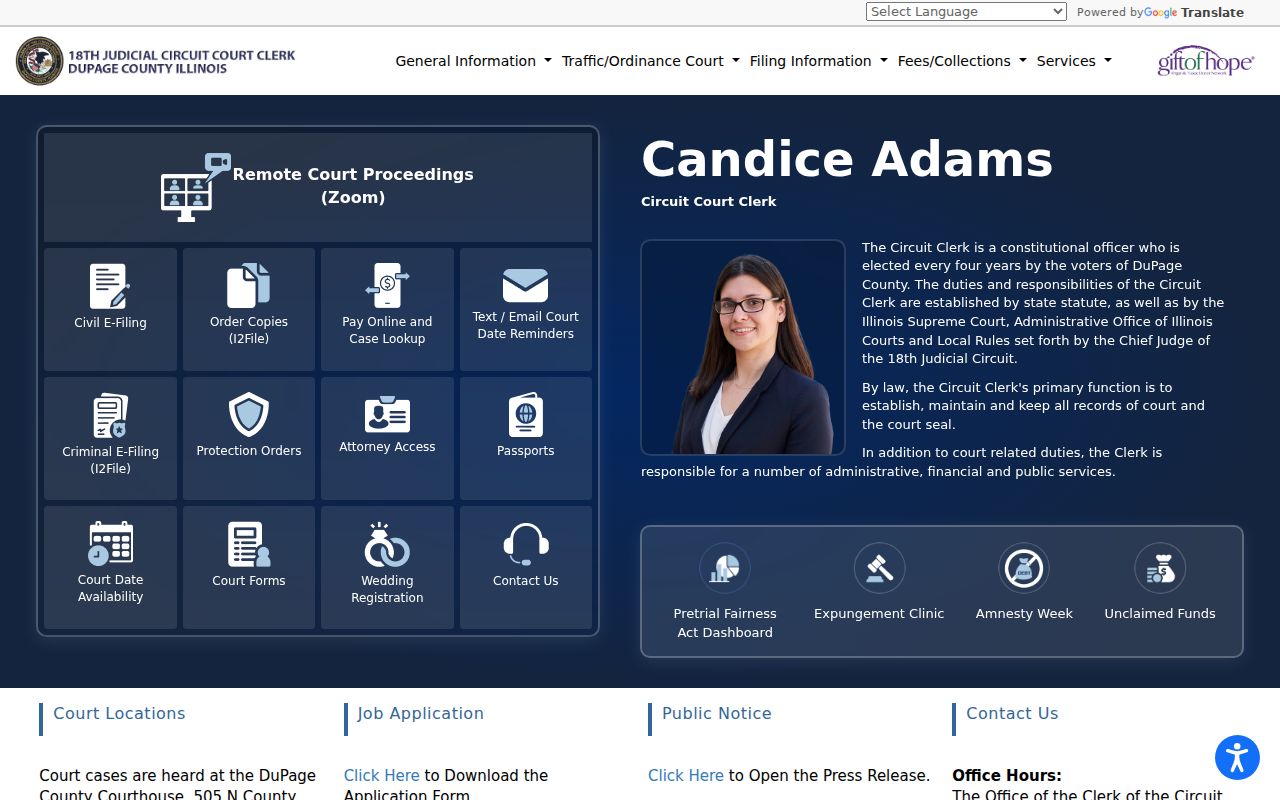
The captured page confirms the custodian and copy path, which matters more than treating a blocked web form as proof that no case exists.
Read Schaumburg Lookup Results
A court result is a lead, not a conclusion. The Cook guide's sample is an illustration rather than a Schaumburg case. It shows the types of fields a researcher should copy into notes while leaving sensitive details out of any public summary.
| Result field | What it establishes |
|---|---|
| Case number | A stable reference for the clerk and copy request |
| Party name | How the person is labeled in that case, not proof of residence |
| File date and type | When the matter began and its procedural category |
| Status | The docket's current summary, which may change or lag |
| Judicial officer | The judge associated with the listed event |
Compare the name with an address, age range, related filing, parcel, or other independent fact. Never assume a common name belongs to the person sought. A disposed case describes docket status, not guilt, current location, or present conduct.
The DuPage public case portal is the live search route when its interactive check is available.
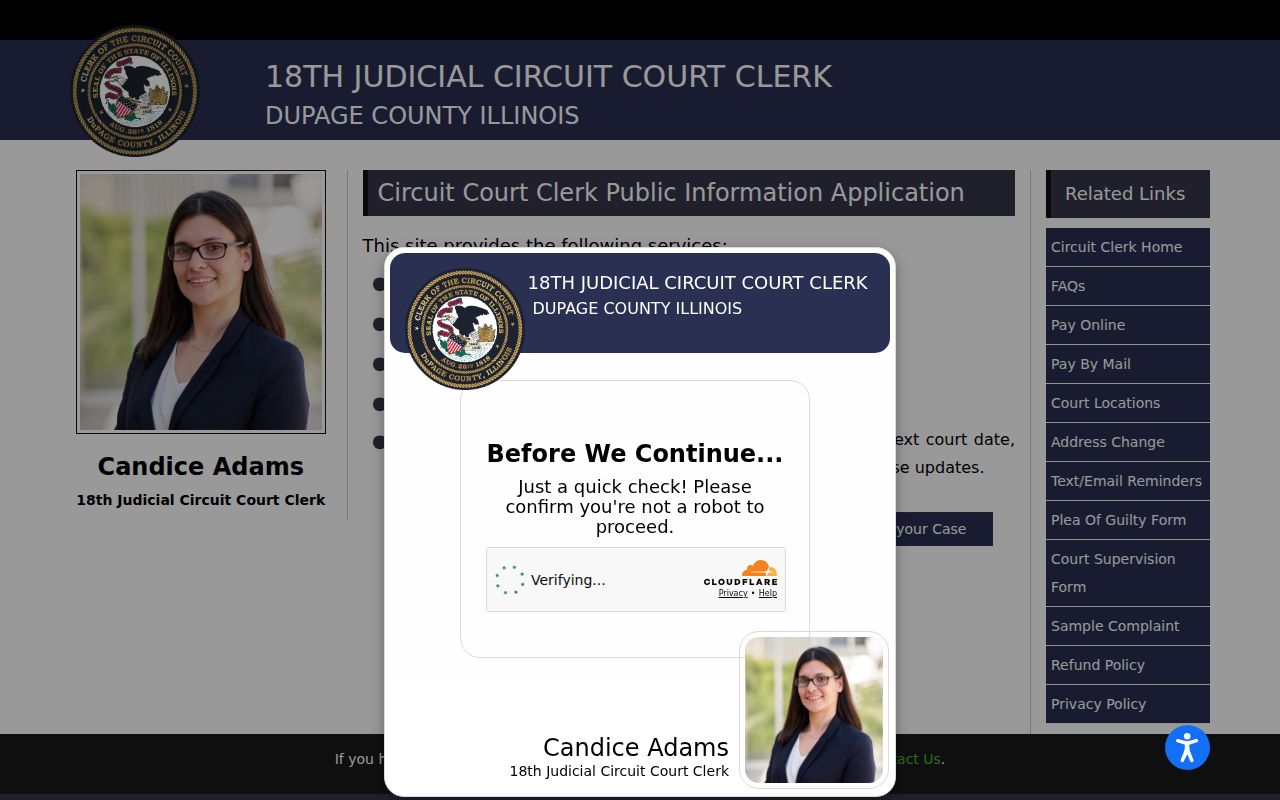
The portal view shows why access can depend on a live session and why the counter and copy channels remain part of a complete search.
Verify Schaumburg Resident Records
A safe Schaumburg search builds a dated chain. Keep each source's scope clear. A parcel owner may not occupy the site, a court party may not live in the village, and a business address may be only a registered office. Two matching identifiers reduce the risk of merging people who share a name.
- Anchor the name to a known address, parcel, school year, event, or public filing. Confirm Cook or DuPage before opening a county portal.
- Run the relevant name index with spelling variants and a date range. Save the record number, source, access date, and exact field labels.
- Compare a second independent source. Match an address, middle initial, associated entity, relative, document number, or event date.
- Request the official file or certified copy when legal proof is needed. Ask the custodian about access, identification, fees, redaction, and correction.
- Docket
- The court's list of filings and events in a case. An online docket is often a summary.
- Index
- A searchable list pointing to records. It may not include the underlying document image.
- Record image
- A scan of the filed document, available online, at a terminal, or by copy request when open.
- Certified copy
- An official copy carrying the custodian's certification for uses that require formal proof.
Note: Record the search date because a docket, license, parcel card, or voter status can change after the lookup.
Schaumburg Family Record Routes
Vital records follow the event county, not simply the person's current city. Cook and DuPage clerks issue county copies under record-specific eligibility rules. The Illinois Department of Public Health handles eligible state copies and marriage verification, while the State Archives and IRAD help with older or genealogical records. IDPH marriage verification covers 1962 to the present, but a certified marriage copy comes from the county clerk.
Birth, death, marriage, adoption, and genealogy requests have different age, identity, relationship, and fee rules. They are not open name-search lists. For a birth parent or adoptee, use Illinois's official adoption registry and confidential-intermediary routes. Closed adoption records should never be bypassed with a private address search. For an heir, search the correct circuit clerk's probate division, then corroborate an open petition or notice with an obituary and recorded transfer.
A former classmate is a strong human-use case for local sources. The Schaumburg Library genealogy collection includes yearbooks, newspapers, church records, databases, and finding aids. A dated yearbook photo, class, and activity can separate two similar names without exposing a current private address.
Confirm Schaumburg Public Affiliations
The Illinois Secretary of State Business Entity Search can search by entity name, registered agent, president, secretary, or manager. Search values can use a file number, keyword, or partial word. A result may show official entity name, formation date, jurisdiction, status, registered agent and office, or listed officers and managers. That proves a filing role, not a home address.
The IDFPR License Lookup adds public license status, number, city and state, issue and expiration dates, and a discipline indicator. It updates daily, with a possible delay after issuance. Cook and DuPage assumed-name filings and Schaumburg business licenses provide other public affiliation trails. Use these sources to confirm how a person is publicly connected to an entity, then compare a second record before treating it as the same person.
Commercial people-finder products merge public, purchased, and inferred data. They may be stale, costly, or join different people. An official filing with a record number gives a clearer correction and copy route than a profile assembled from unknown sources.
Schaumburg Dockets Versus History
A court docket and an Illinois criminal-history response are different records. The docket tracks one court matter. The Illinois State Police criminal-history program explains the state's conviction-record scope and identity limits. A name-only result can confuse people with similar names, so fingerprints provide a stronger identity check where the official process calls for them.
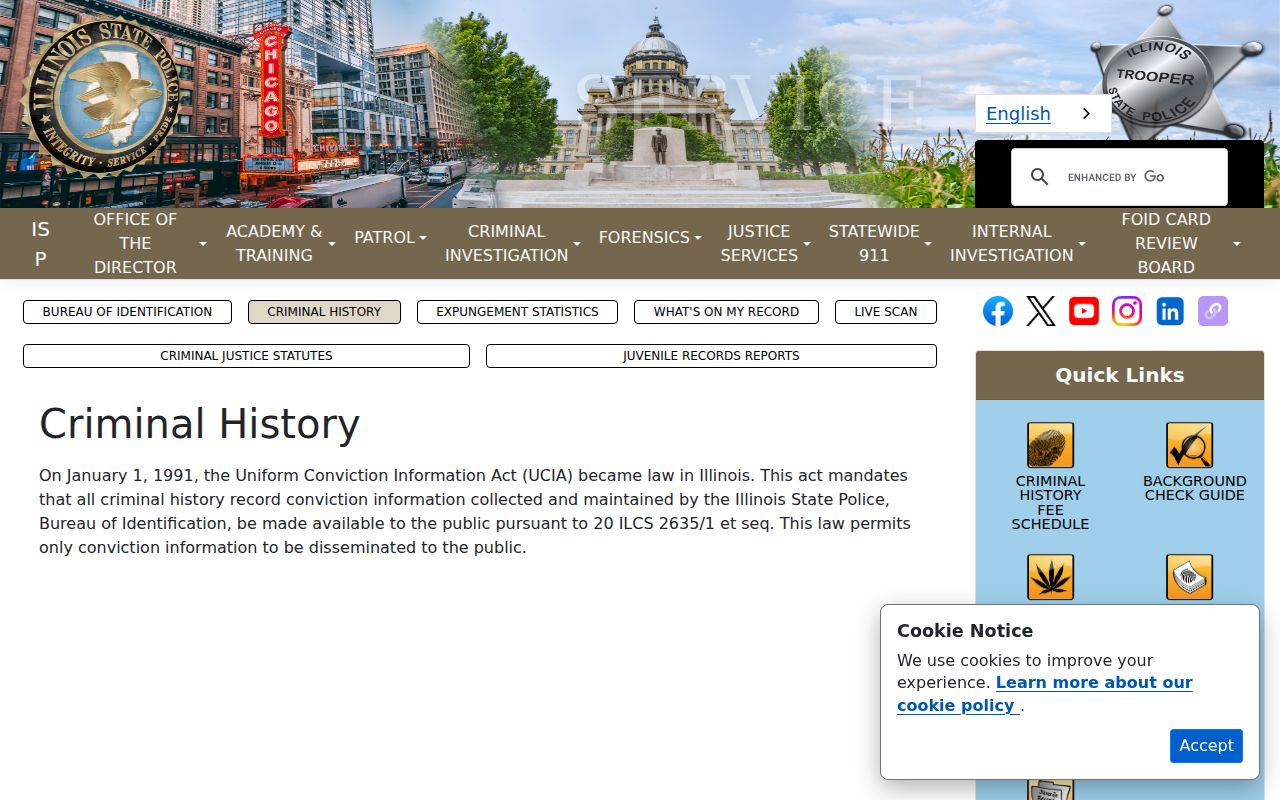
The state page reinforces the need to distinguish an identity-based state response from a public court name search.
The Illinois State Police registry has its own name, birth date, city, ZIP, county, status, custody, and record-type fields. The database says it updates daily, yet it is not a complete criminal history and must not be used to threaten or harass anyone.
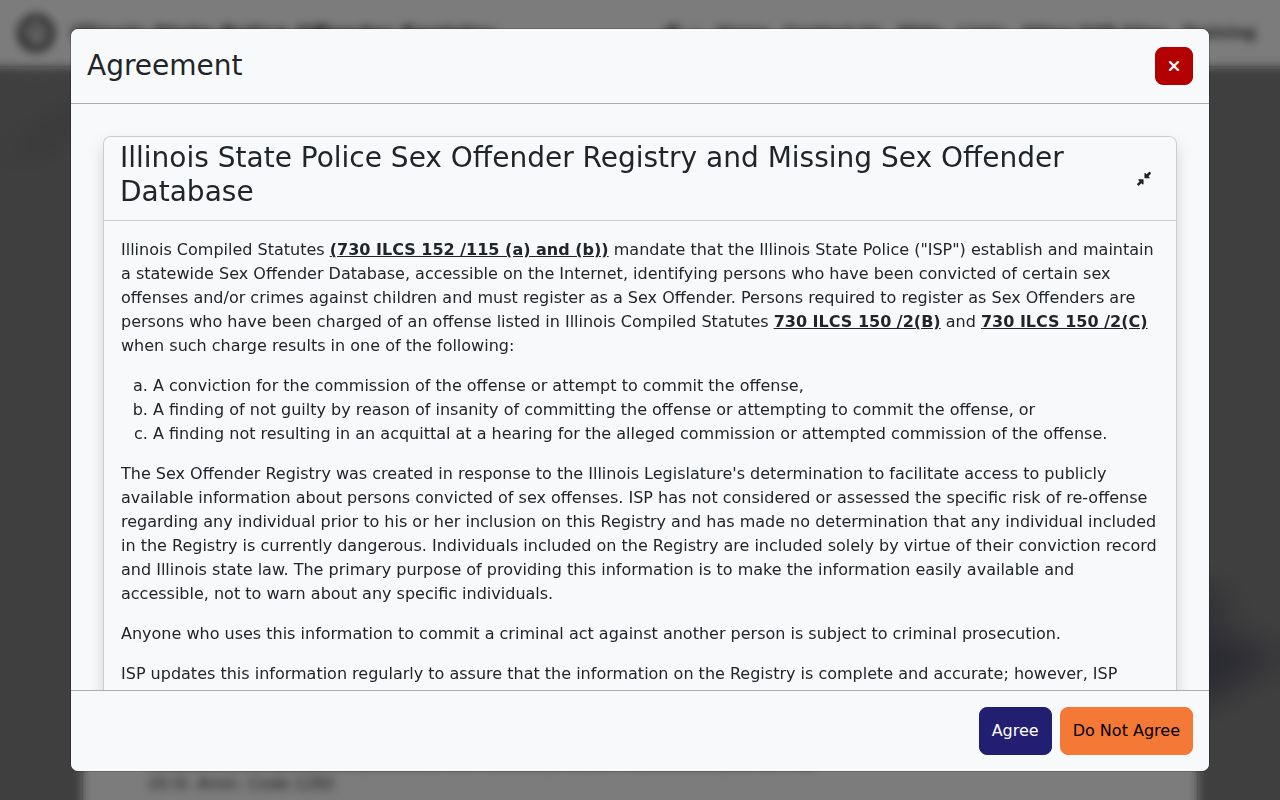
The registry capture shows a sensitive, purpose-limited official route, not a general list of Schaumburg residents.
Schaumburg Lookup Request Fallbacks
When an online portal stops, move to the custodian instead of declaring that no record exists. Illinois FOIA accepts written requests that reasonably describe public records. An ordinary response is generally due within five business days, subject to a permitted extension, exemptions, and fee rules. FOIA does not force an agency to answer a broad question, create a new household list, or release a protected record.
For village permits, licenses, police or fire records, use the Schaumburg FOIA Center. Electronic requests are free. The first fifty letter or legal pages are free, then the published charge is fifteen cents per page. For county court files, use the public terminal, clerk counter, mail or copy-order route. For older vital and genealogy material, ask the county clerk, IDPH, State Archives, or IRAD which collection and age rule applies.
A useful request names the record type, person or parcel only as needed, date range, likely office, and known record number. Ask for an index entry first if a whole file may be restricted. Staff can explain fields, public access, fees, and correction routes, though they generally cannot confirm that an unknown record belongs to a specific person.
Schaumburg Resident Lookup Limits
Protected voter addresses, DMV personal information, utility customer records, sealed or expunged court files, adoption records, and many household details do not become public because a name is known. Illinois voter rules withhold sensitive identifiers and limit use of voter data. A missing result may reflect confidentiality, a spelling issue, the wrong county, a portal barrier, or a coverage gap.
The Illinois Address Confidentiality Program gives qualifying survivors a substitute address and mail forwarding. It is free and does not require a police report or protective order. It does not erase older records or guarantee property-record secrecy. Respect a protected address and stop the search rather than trying to defeat the safeguard.
Errors should go back to the original custodian. Depending on the source, that may mean an assessor correction or appeal, a recorded corrective document, a voter-registration update, a court request, or an Illinois State Police challenge. Copying a suspected error into another record only makes the identity problem worse.
Lawful use. Search Schaumburg records only for lawful personal research. Never use a name, address, docket, registry entry, or family record to stalk, harass, threaten, or harm anyone.